AI brand management, from sources to content.
BrandSuite is AI brand management software that organizes sources, visual identity, voice and messaging into reusable context for on-brand content. Your team checks drafts and decides what to approve. Workspace access is available on request.
Starts with → You get
- For
- Brand teams and organizations that need to reuse identity and knowledge without losing sources.
- Starts with
- Website, authorized files, current identity, voice, offer, audience and selected social signals.
- You get
- Reusable brand context with evidence groups, identity, voice, audience and provenance.
- You decide
- Which signals become shared rules and which remain observations to verify.
- BrandSuite analyses the website structure, language and visual library.
- Social sources are captured in a later step and remain attributed.
- Evidence becomes reusable knowledge with its source, status and media preserved.

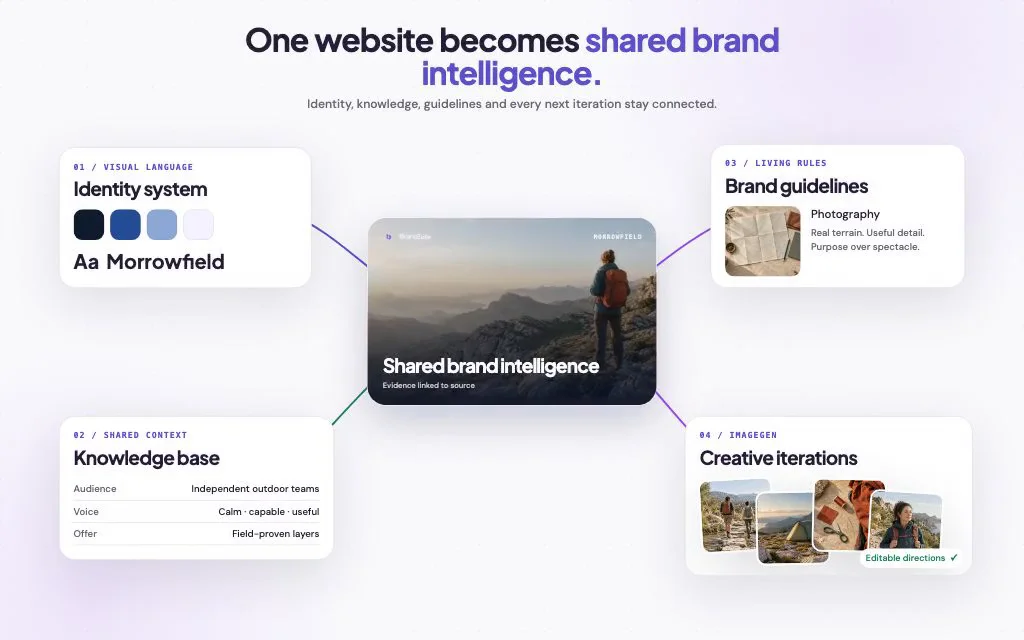
The website becomes a system ready to use.
The Morrowfield example shows how visual and language signals become an identity system, knowledge base, guidelines and new iterations.
- Source
- Public pages and imagery retain provenance
- Identity
- Palette, typography and photography direction
- Knowledge
- Audience, voice and offer in shared context
- Use
- Strategy, guidelines, social and canvas
On-brand AI content with sources and review
Brand context is the set of sources, audience, voice and constraints used to guide a draft. It is not the model's context-window size.
Editorial example using the fictional Morrowfield brand. Not a live tool result or a customer case.
- Same task, without brand context
- Task: write a jacket launch post. A generic illustrative draft might say: “Discover the ultimate jacket for every adventure.” It offers an absolute claim without evidence.
- With the brief and brand rules
- Brief: Morrowfield hiking jacket; practical voice; no unverified waterproof claims. Editorial draft: “Check the route. Pack your layers. Explore the Morrowfield jacket and its construction details.”
Read the brief, decisions and limits
- Human decision
- The reviewer checks construction details against approved sources and removes unsupported statements. This comparison explains the method; it is not a model benchmark or a guarantee.
From sources to verifiable brand rules
AI brand management software should connect each rule to a source and make it usable in content. In BrandSuite, organize visual identity, voice, audience and messaging, then compare drafts with approved decisions. This workflow helps create on-brand content while your team retains responsibility for the facts.
Record provenance
For each source, record its URL or document, review date and scope: product, audience, identity or communication. Remove outdated material from the working brief.
Distinguish facts from assumptions
A declared font is observable evidence. An audience description may be an inference. Label assumptions and ask the brand owner to confirm them.
Apply rules to a concrete task
The Morrowfield example requires a practical voice and prohibits waterproof claims without evidence. Compare a post and campaign page: both should preserve that constraint and point to construction details. Revise copy and CTA if they add unsupported promises; a rule in context does not guarantee every draft follows it.
Review before reuse
Correct the content, record decisions and apply them to subsequent variants. Recheck evidence and rights when sources or goals change.
Final check: a technically complete draft may still need editorial review. Brand rules do not guarantee rankings or recommendations in AI answers.
Compare AI brand and content softwareStart with a website brand kit